Understanding The Two Primary Models of Chemical Manufacturing
Selecting a toll blending partner is a critical decision for any procurement manager or product lead. The choice often comes down to who manages the raw material supply chain. In a customer-supplied model you provide the raw ingredients and the blender provides the labor and equipment. In a turn-key model the blending partner handles everything from sourcing chemicals to final packaging. Each path has distinct impacts on your overhead and your speed to market. Choosing the wrong one can lead to hidden costs or supply chain bottlenecks. Douglas ProTech offers both models to fit different operational scales.
The Customer-Supplied Model and When it Works
The customer-supplied model is often preferred by larger OEMs with established global procurement contracts. If you already have high-volume pricing for specific raw materials you may save money by leveraging those existing vendor relationships. You ship the components to the blender and pay a fee for the conversion process. This gives you total control over the specific chemical grades used in your formula. It is a good fit for companies with robust internal logistics teams who can manage the timing of multiple inbound shipments.
However this model places a heavy administrative burden on your team. You are responsible for managing inventory levels at a third-party facility. If a shipment of a single minor additive is delayed, the entire production run stops. You must also account for the hidden costs of freight and the risk of raw material shrinkage during handling. For many smaller teams, these logistical hurdles outweigh the perceived savings of direct sourcing. You are essentially acting as your own general contractor for the manufacturing process.
Why Turn-Key Toll Blending is Gaining Popularity
Turn-key toll blending simplifies the entire production cycle. Under this model, the blender uses their own purchasing power to source all raw materials. They handle the quality control of incoming shipments and manage all vendor relationships. This shifts the risk of supply chain volatility away from your company. You receive a finished product and pay a single price per unit. This predictability is valuable for budgeting and financial planning.
Turn-key solutions are particularly effective for product managers launching new service fluids. It allows you to focus on marketing and sales rather than chemical procurement. The blender often has long-standing relationships with chemical distributors and can navigate shortages more effectively than a one-time buyer. This model also reduces the amount of capital tied up in raw material inventory on your balance sheet. You only pay for the final product as it is delivered to your warehouse.
Packaging and Scalability Considerations
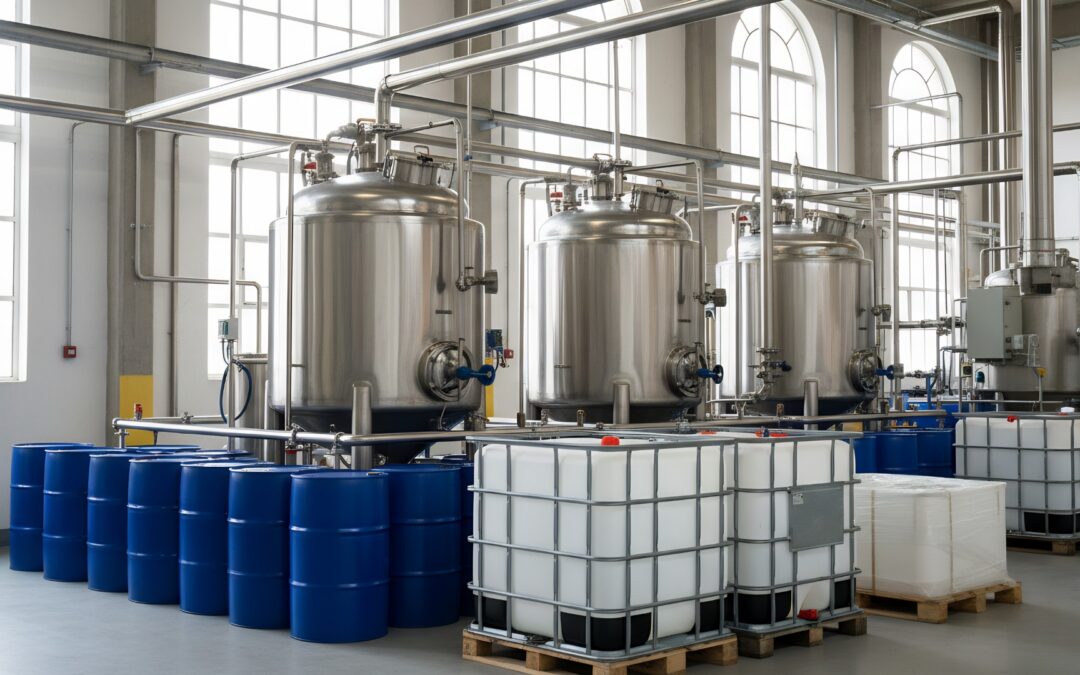
The versatility of your blending partner is just as important as the sourcing model. A true turn-key partner should offer a wide range of packaging options to meet diverse market demands. Douglas ProTech provides extensive packaging and repackaging capabilities to accommodate various project sizes, as well as label design if needed. We can handle small 2 oz containers for retail or specialty applications. We also support mid-sized options like 1 gallon bottles or 5 gallon pails.
For larger industrial or commercial requirements we provide 55 gallon drums and 275 or 330 gallon totes. If your project demands high-volume logistics, we can manage 4,500 gallon tanker truckloads. This flexibility is essential for products that might start small but scale rapidly. Having one partner who can grow with your brand prevents the need for costly migrations between manufacturers later on. You can test a market with small batches and shift to bulk logistics as demand increases.
Logistics and Final Delivery
Logistics management is the final piece of the turn-key toll blending custom dilution puzzle. A turn-key partner manages the shipping of the finished goods to your distribution centers. They ensure that all hazardous material labeling and shipping documentation are compliant with current regulations. This reduces the risk of legal issues or fines during transit. When you supply your own materials you often have to coordinate these outgoing shipments yourself which adds another layer of complexity.
Turn-key blending provides a single point of accountability for the entire project. If there is an issue with the final product quality or a delay in delivery, you only have one contact to call. In a customer-supplied model the blender might blame the raw material vendor and the vendor might blame the blender. This finger-pointing can be avoided by choosing a partner who takes ownership of the entire process from the initial purchase order to the final delivery.
Beyond simple accountability, a turn-key provider also manages the fluctuating costs of freight and fuel surcharges. They use their established carrier networks to find the most efficient routes and the most reliable drivers. This means your product does not sit on a loading dock waiting for a truck that never arrives. Because they handle the inventory from start to finish, they can better predict lead times and keep your production schedule on track. Managing these moving parts internally requires dedicated staff and expensive software that many companies would rather avoid. Outsourcing this complexity allows you to treat your chemical manufacturing as a predictable line item rather than a logistical nightmare. It turns a fragmented supply chain into a streamlined asset for your business growth.
Making The Final Decision for Your Brand
Deciding between these two models requires an honest assessment of your internal resources. If your procurement team is already overextended, a turn-key model is almost always the better choice. It frees up your staff to work on higher-value projects while an expert manages the day-to-day manufacturing details. If you have extremely specialized ingredients that only you can source, the customer-supplied model might be necessary.
Evaluate the total cost of ownership rather than just the price per gallon. Factor in the time spent on logistics and the cost of maintaining safety data sheets. Most modern companies find that the speed and simplicity of turn-key toll blending provides a better return on investment. If you are ready to discuss your specific custom dilution needs or need a quote for a specific container size, contact Douglas ProTech. We can help you determine which model fits your current production goals and your long-term growth strategy.
Schedule a Consultation
Whether you need a specialized 2 oz retail bottle or a 4,500 gallon tanker truckload, we have the infrastructure to scale with your brand. Our facility is designed to handle the complexities of both hazardous and non-hazardous blending with a focus on precision and safety. During a consultation we can review your safety data sheets and provide a realistic timeline for your first production run. This proactive approach prevents the common delays associated with raw material shortages or labeling compliance issues. You can also explore our repackaging capabilities for existing products that need a more efficient distribution format.
Contact Douglas ProTech to schedule a time to discuss your project in detail. Our team of experts is ready to provide the guidance you need to select the most cost-effective and reliable manufacturing model for your service fluids. You can use our online contact form to provide your project specifications or call us directly to speak with a project manager. Taking the time to align your production model with your business goals now will save you countless hours of administrative work in the future. We look forward to becoming your trusted partner for all your toll blending and custom chemical needs.